Buying guide · 6 min read · updated 2026-08-21

Class 1, 2 and 3: which e-bike you can ride, and where

The difference that decides whether you're allowed in the bike lane, on the trail, or neither

In the US, e-bikes aren't all treated the same. There are three classes, and the class decides something very concrete: where you're allowed to ride. It's the first thing you should check β€” and, oddly, the figure most Amazon listings leave out.

This guide explains the three classes, what federal law allows, and what to verify before you hit buy.

1. The three classes, one line each

  • Class 1: assists only while you pedal and cuts out at 20 mph. No throttle. It faces the fewest restrictions: allowed on practically any bike lane and on most trails.
  • Class 2: has a throttle and moves without you pedaling, also up to 20 mph. Allowed in nearly all bike lanes, but many parks and natural-surface trails ban it.
  • Class 3: assists only while pedaling but reaches 28 mph. It's the commuter's class. In exchange it's usually banned from trails, and some states require a helmet and set a minimum age.

The maximum power in the federal definition is 750 W (1 hp). Above that, it is legally not a bicycle.

2. Why this actually affects you

This isn't paperwork. Class determines three practical things:

  • Where you can ride. Many counties allow Class 1 and 2 in bike lanes but reserve natural-surface trails for Class 1. Class 3 is shut out of a good number of recreational routes.
  • Whether you need a helmet, and how old you have to be. Several states require a helmet on Class 3 and set a minimum age, usually 16.
  • Whether insurance covers you. A bike over 750 W or 28 mph can be classed as a moped, and then everything changes: registration, insurance and a license.

The specific rules are set by each state, and some counties and parks add their own on top. Before buying, check your state's website and the park you plan to ride.

3. Watch out for listings that don't state the class

Here's the real trap in buying on Amazon. Plenty of listings brag about "1500W peak" and "30+ mph" without saying which class the bike fits. Those two numbers together describe something that in many states is no longer a bicycle.

Mind the watts trap: manufacturers usually quote peak power, an instantaneous maximum, rather than nominal power, which is what the law counts. A bike advertised at "1500 W peak" can be perfectly legal if its nominal rating is 750 W. Always look for the word nominal or continuous.

Simple rule: if the listing states neither the class nor the top speed, ask the seller in writing before you buy. If they don't answer, you've learned plenty about their after-sales support.

4. What you should actually compare

Once the class is settled, this is what separates a good bike from a cheap one:

  • Hydraulic versus mechanical brakes. On a bike of 80 pounds or more, cables fall short. It's the upgrade you notice most.
  • Battery watt-hours (Wh). That's the real measure of range; advertised miles are measured in the softest mode with no wind. Multiply volts by amp-hours: 48V Γ— 15Ah = 720 Wh.
  • Removable battery. If you live in an apartment, being able to carry just the battery upstairs changes everything.
  • Warranty. One year is standard. Six months is thin. And check whether it covers the battery and motor, which are the expensive parts.
  • UL2849 certification. It covers the complete bike, not just the cell. A growing number of buildings and cities now require it to store or charge an e-bike indoors.

In short: check the class before the price, insist on nominal rather than peak power, and put hydraulic brakes and a long warranty ahead of a big wattage number in the headline.
Our picks

Sorted by this guide's criteria across the bikes we've reviewed.

1
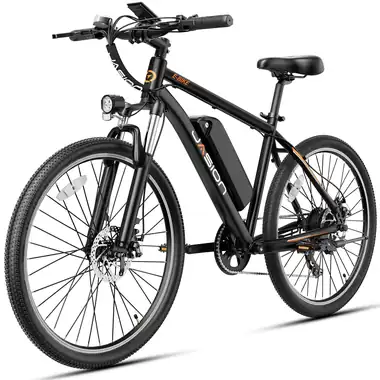
Jasion EB5 26"
Amazon's #1 best seller, and 2,329 ratings back it up.

Jasion EB5 26"

A first e-bike on a tight budget, for someone who wants the model the largest number of people have actually bought and rated rather than the one with the prettiest spec sheet.

Claimed range
40 miles
Nominal power
β€”
Bike weight
49,6 lb
Battery
500 Wh
$339.99price as of 2026-08-21
2
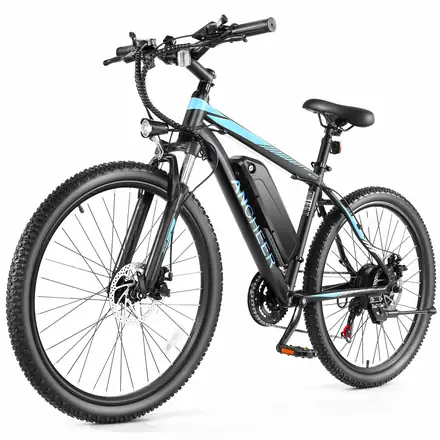
ANCHEER Sunshine 26"
$400, 597 reviews and UL2849 certification: the sensible way in.

ANCHEER Sunshine 26"

Someone trying an e-bike without spending more than $500, riding under 20 miles at a time, who needs it certified to store or charge inside the building.

Claimed range
55 miles
Nominal power
500 W
Bike weight
β€”
Battery
374 Wh
$399.99price as of 2026-08-21
3
TST R004 Fat Tire
Amazon's #1 best-selling bicycle. 457 ratings, and one spec that can't be true.

TST R004 Fat Tire

A first fat-tire e-bike on a budget, for someone who wants the model the most people have actually bought β€” and who budgets for a brake upgrade.

Claimed range
60 miles
Nominal power
750 W
Bike weight
β€”
Battery
720 Wh
$569.99$599.99-5 %price as of 2026-08-22
4
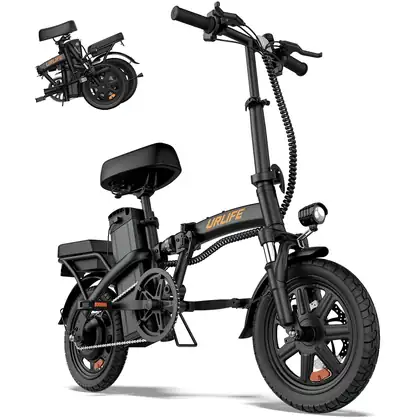
URLIFE F1L 14" Folding
Amazon's #1 folding best seller, UL 2849 certified, $259.99.

URLIFE F1L 14" Folding

Flat, short, paved trips where folding matters more than riding quality: last-mile from a commuter train, a campus, a small apartment with no storage. Not for hills, not for distance.

Claimed range
40 miles
Nominal power
β€”
Bike weight
β€”
Battery
375 Wh
$259.99price as of 2026-08-21
5
Hopepeak Z10 Folding
648 Wh and a 400 lb payload in a bike that folds β€” for $469.

Hopepeak Z10 Folding

Someone who needs a bike that fits in a car and still carries real weight, rides on mixed surfaces, and doesn't need to carry it up stairs.

Claimed range
80 miles
Nominal power
β€”
Bike weight
β€”
Battery
648 Wh
$469.00price as of 2026-08-21
6
TST R7 Fat Tire
The cheapest fat tire with dual suspension and 84 real reviews behind it.

TST R7 Fat Tire

Someone getting into fat tire e-bikes on the smallest budget, riding mostly on paths and quiet streets, who doesn't mind upgrading to hydraulic brakes later.

Claimed range
60 miles
Nominal power
750 W
Bike weight
87,7 lb
Battery
720 Wh
$699.99$799.99-13 %price as of 2026-08-21
7
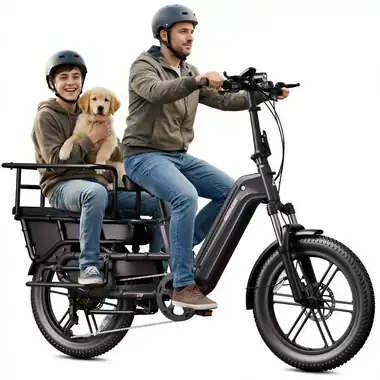
SISIGAD Family Cargo
The only one here built to carry a child β€” and UL2849 certified.

SISIGAD Family Cargo

A parent doing the school run and short errands who wants to leave the car at home, and values the certification and the hydraulic brakes over having a long ownership record to read.

Claimed range
60 miles
Nominal power
750 W
Bike weight
β€”
Battery
720 Wh
$999.99price as of 2026-08-21
8
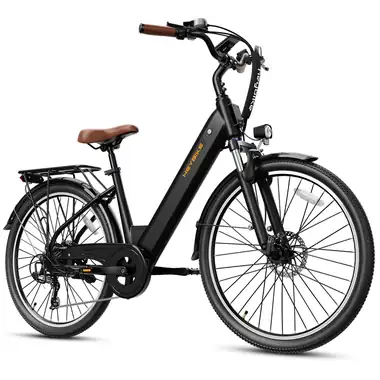
Heybike Cityscape 2.0
A known brand, a UL-certified battery and $110 off.

Heybike Cityscape 2.0

Someone who wants a known-brand commuter that handles bad weather, values the certified battery and the rack, and doesn't need to go fast.

Claimed range
50 miles
Nominal power
500 W
Bike weight
β€”
Battery
468 Wh
$699.00$809.00-14 %price as of 2026-08-21
9
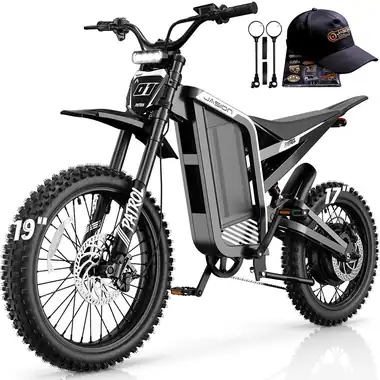
Jasion Patrol 52
The fastest and best rated β€” but legally it isn't a bicycle.

Jasion Patrol 52

Someone after a light electric dirt bike for private land, a property or a track, who understands it can't legally be used as a bicycle on public roads. If you want to commute in the bike lane, this isn't your machine.

Claimed range
50 miles
Nominal power
β€”
Bike weight
β€”
Battery
β€”
$1,199.99price as of 2026-08-21
10
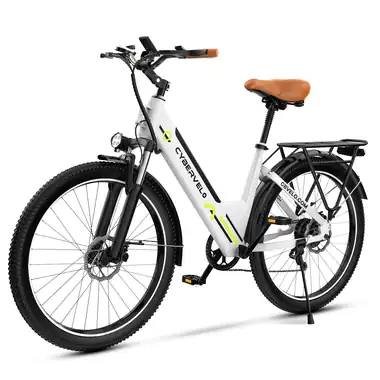
Cybervelo EK2 26"
A well-equipped commuter with 110 reviews β€” and a listing that can't keep its numbers straight.

Cybervelo EK2 26"

Someone who wants a fully equipped commuter under $600 and is willing to email the seller for the real power and battery figures before buying.

Claimed range
80 miles
Nominal power
β€”
Bike weight
β€”
Battery
β€”
$599.00price as of 2026-08-21

Affiliate links: if you buy through them we earn a commission from Amazon at no extra cost to you. Learn more.

Compare them side by side

Frequently asked questions

Do I need a license or insurance for an e-bike in the US?

For Class 1, 2 and 3 you don't need a license or registration in most states, because they legally count as bicycles. A helmet and a minimum age may be required for Class 3. If the bike exceeds 750 W nominal or 28 mph, many states treat it as a moped, and then you do need a license, plates and insurance.

What's the difference between nominal and peak power?

Nominal is what the motor can sustain continuously, and it's the figure the law uses. Peak is an instantaneous maximum lasting a few seconds, on a start or a climb. A listing that just says "1500W" without specifying almost always means peak.

How long does an e-bike battery last?

Between 500 and 1,000 full charge cycles, which in normal use is about 3 to 5 years before capacity drops noticeably. It lasts longer if you don't leave it flat for months and avoid charging to 100% when you won't be riding soon.

Can I carry a passenger on the rear seat?

It depends on your state and on whether the bike is designed for it, with an approved saddle and footpegs. Even when the manufacturer advertises it, some states prohibit passengers on a bicycle except in approved child seats. Check first.